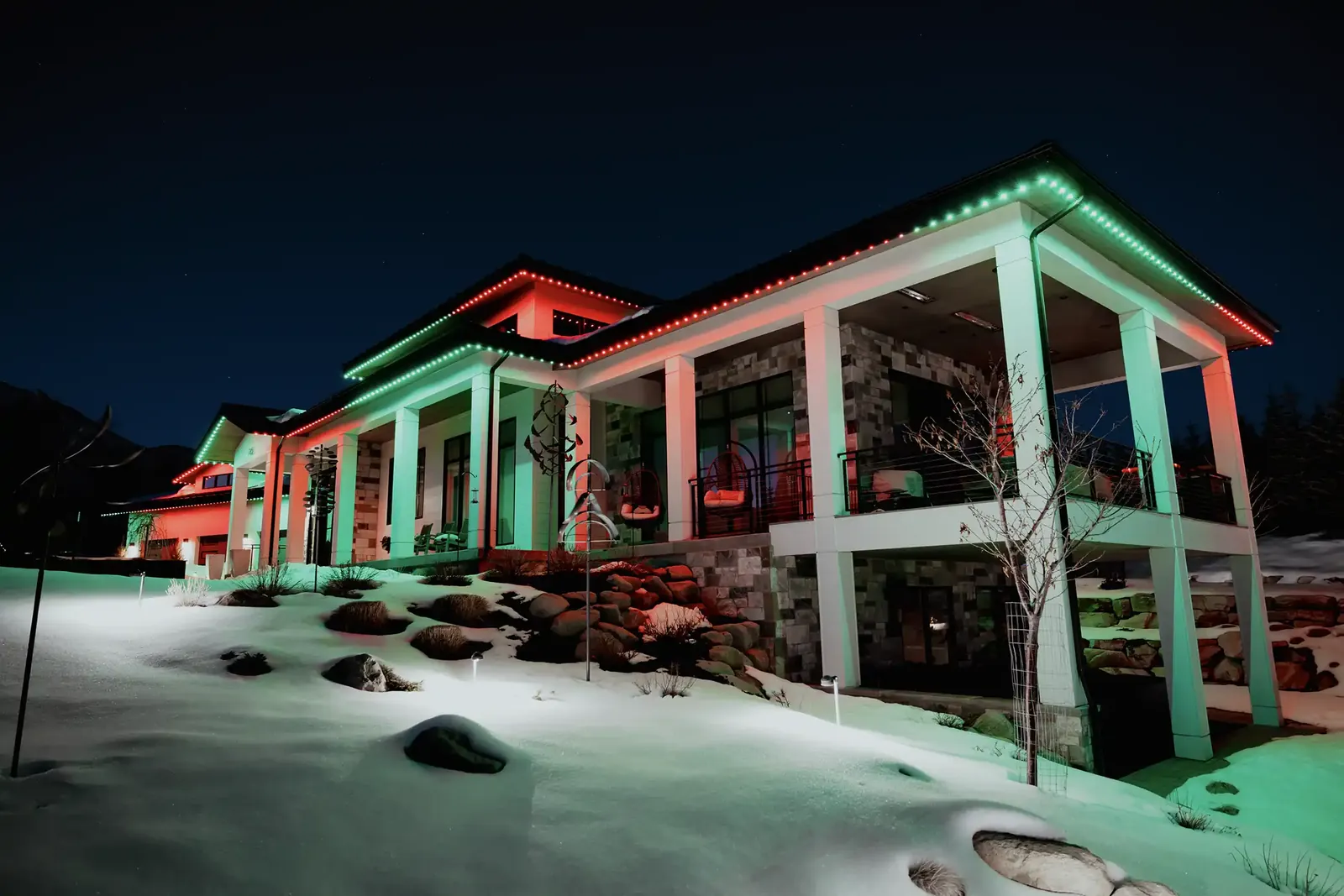
Where the track sits matters most
The track mounts beneath the eave, against the soffit or the fascia, not in the gutter and not on the roof edge. Snow that slides off the shingles passes over it, and ice that forms in the gutter forms beside it, not on it. That placement is the single biggest reason permanent lights last where seasonal clips do not.
The track is fastened to the house, never clipped to the gutter, so wind across open farm ground does not lift it.
Sealed lights, low voltage
The lights are sealed to IP67, a rating for dust and for temporary immersion in water, so rain, melting snow and ice have no way in. Low voltage runs along the track from a plug-in supply, so there is no exposed line voltage outside the house.
Freeze and thaw, and wind
A Central Illinois winter swings above and below freezing for weeks. The track and the lights are made to expand and contract with that, and the finish does not need repainting. Wind is a fastening question, and the track is fastened to the structure at regular intervals along its whole length.
Open ground, lakes and river bluffs
Central Illinois has three kinds of winter exposure. On open farm ground, wind and drifting snow are the test. On river bluffs and lake shores, wind funnels along the water and the air stays damp. In town, trees and neighboring houses break the wind, and ice in the gutters is the bigger concern. The track is fastened beneath the eave along its whole length in every case; what changes is where we look hardest at the trim and where the snow slides.
Short days and the schedule
In December the sun sets around 4:30 in Central Illinois. The schedule follows sunset through the year, so the house is lit when you come home and the lights go off at the hour you choose. Christmas scenes run on a calendar you set once.
What waits for spring
Roofline lighting can be installed through most of the year. Landscape lights and in-ground speakers need ground that is not frozen, so in deep winter we may plan those parts for spring. Your proposal says which parts go in when.
What we check before we install
Winter is hardest on whatever the track is fastened to, so the consultation starts with the house itself. We look at these with you, and tell you before anything is installed if one needs attention first.
- Fascia and soffit. Sound trim holds a fastener through years of freeze and thaw. Soft or peeling wood is repaired first.
- Gutters. A gutter that overflows or pulls away sends water and ice where it should not go. It is worth fixing with or without lights.
- Where the power comes from. The supply plugs into an outdoor outlet with a weather cover. If there is none near the roofline, a licensed electrician adds one.
- Where snow slides. On a steep or metal roof we note where the snow comes off, and keep the track tucked back beneath the eave there.
Questions to ask any installer
Whoever you hire, these four answers tell you how the lights will do in February.
- Is the track fastened to the house, or clipped to the gutter?
- What is the weather rating of the lights, in writing?
- What does the warranty cover, and who comes out if a light fails in January?
- Is any line voltage run outside, or is everything low voltage from a plug-in supply?
Care through the season
There is nothing to put up or take down. Keep gutters clear as you normally would, and if an ice dam forms, have it treated the way you would without lights; the track sits below it. If a light ever fails, the warranty terms in your proposal say how it is handled, and we stay a message away for service.